Map roast stages to flavour outcomes
title: "Map roast stages to flavour outcomes" tags: [coffee/roasting] status: Draft aliases: [] related: []
Below is a stage-by-stage mapping of coffee roast progression to flavour outcomes, structured the way professional roasters and educators typically frame it.

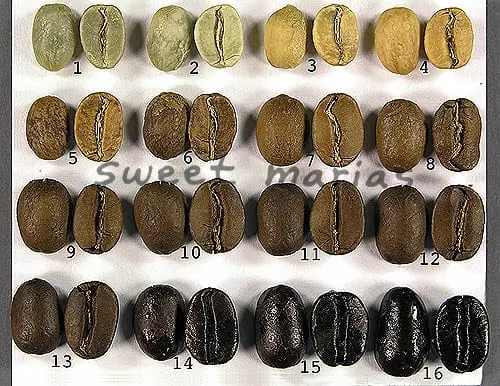


Green → Yellow (Drying Phase)
Sensory state
-
No “coffee” flavour yet
-
Grassy, cereal, hay-like aromas
Flavour implications
-
Uneven drying leads to hollow or baked cups later
-
Proper drying sets the foundation for clarity and balance
Key risk
- Rushing → scorched exterior, raw interior
Yellow → Light Brown (Maillard Phase)
Dominant reactions
- Maillard reactions (sugars + amino acids)
Flavour outcomes
-
Sweetness begins to form
-
Toast, biscuit, malt, nut
-
Increased body and mouthfeel
Roaster leverage
-
More time here = greater sweetness and balance
-
Too little = sharp acidity, thin body
First Crack (Light Roast Threshold)
Structural change
- Bean expansion and porosity increase
Typical flavours
-
Bright acidity
-
Floral, citrus, stone fruit
-
High origin clarity
Acidity profile
- Lively, crisp, sometimes wine-like
Common risks
- Underdevelopment → sour, grassy, peanut-like
Early Development (Light–Medium Roast)
Chemical focus
-
Controlled caramelisation
-
Acid smoothing
Flavour outcomes
-
Sweet citrus, apple, pear
-
Honey, light caramel
-
Balanced acidity and sweetness
Typical use
-
Specialty filter coffee
-
Origin-forward espresso
Mid Development (Medium Roast)
Chemical focus
-
Deeper caramelisation
-
Reduced volatile acids
Flavour outcomes
-
Milk chocolate, caramel
-
Roasted nuts
-
Rounded body, reduced sharpness
Balance
-
Peak “crowd-pleaser” zone
-
Origin character still present, but softened
Late Development (Medium-Dark Roast)
Structural change
- Oils begin migrating outward
Flavour outcomes
-
Dark chocolate, cocoa
-
Toasted sugar, molasses
-
Lower acidity, heavier body
Trade-off
- Increased roast character at expense of origin nuance
Second Crack (Dark Roast Threshold)
Structural breakdown
-
Cellulose fracture
-
Surface oils appear
Flavour outcomes
-
Smoky, spicy, carbonised notes
-
Bitter chocolate
-
Very low acidity
Common descriptors
- Char, ash, tobacco, burnt sugar
Beyond Second Crack (Very Dark Roast)
Dominant flavours
- Carbon, smoke, bitterness
Outcome
-
Origin indistinguishable
-
Roast defects amplified
Use cases
-
Rare in specialty
-
Occasionally for traditional or blended styles
Summary Table (Condensed)
| Roast Stage | Acidity | Sweetness | Body | Dominant Flavours |
|---|---|---|---|---|
| Light | High | Moderate | Light | Floral, citrus, fruit |
| Light–Medium | Balanced | High | Medium | Fruit, honey, caramel |
| Medium | Moderate | High | Medium–Full | Chocolate, nuts |
| Medium–Dark | Low | Moderate | Full | Cocoa, molasses |
| Dark | Very Low | Low | Heavy | Smoke, ash |
Key Insight
Flavour is not determined by temperature alone, but by time allocation across stages, especially:
-
Maillard duration (sweetness and body)
-
Development time after first crack (balance vs bitterness)
This framework is particularly useful for:
-
Teaching roasting fundamentals
-
Designing roast profiles
-
Explaining flavour differences to customers
A one-page printable teaching chart